
Heavy Equipment for Excavation in Houston, TX: How the Right Machines Make the Difference
Table of Contents
Equipment selection is one of the less visible but more consequential decisions an excavation contractor makes before a project starts. Use the wrong machine for the site conditions and you get subgrade damage, schedule delays, or work that has to be redone. Use the right combination and the project moves efficiently from mobilization to closeout with fewer surprises.
In the Greater Houston area, equipment selection is complicated by the region’s expansive clay soils, high water table, variable lot sizes, and the mix of residential, commercial, and industrial project types across Harris, Fort Bend, Waller, and Montgomery Counties. Here’s a look at the primary equipment Wikota Excavation operates, what each machine does, and how site conditions in Houston drive those decisions.
Primary Excavation Machines: Matching Equipment to Scope
Hydraulic Excavators
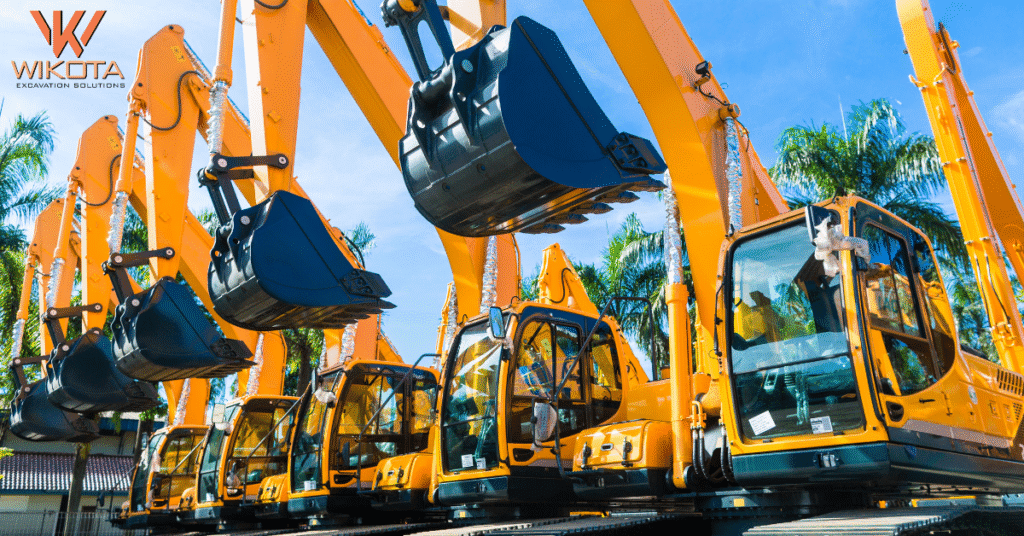
The hydraulic excavator is the core machine on most excavation projects — residential foundations, commercial mass grading, utility trenching, and bulk earthmoving all rely on it. Excavators are sized by operating weight and bucket capacity, and matching machine size to project scope matters more than most owners realize. Undersized excavators slow down large projects; oversized machines on confined residential lots cause subgrade disturbance and access problems.
On Houston’s clay-heavy soils, tracked excavators provide the stability and ground pressure distribution that wheeled equipment often cannot. When soils are wet and saturated — a common condition across the Houston metro during and after heavy rainfall — tracked machines are typically the only viable option for maintaining grade accuracy and avoiding subgrade rutting.
Bulldozers
Bulldozers handle rough grading, site clearing, and cut-and-fill operations that require moving large volumes of material across a site. For new residential developments in Waller and Montgomery Counties where lots are uncleared and the existing grade needs significant reshaping, a bulldozer establishes the baseline terrain that finer grading equipment works from.
Track width and blade configuration affect how a dozer performs on Houston’s soils. Wider tracks distribute machine weight across a larger footprint, reducing subgrade disturbance on wet or marginal sites. Experienced operators understand when to push aggressively and when to back off to protect the subgrade they’ll need to compact later.
Motor Graders
Motor graders are finish grading tools — they bring rough-graded terrain to the precise elevations specified in the civil grading plan, including the drainage slopes that direct stormwater away from structures. In the Houston market, where drainage grades are not a design preference but a flood mitigation requirement, the precision of the finish grade directly affects whether a site performs as engineered.
GPS-guided motor graders allow operators to work from a digital grade model rather than relying entirely on physical grade stakes, which improves accuracy and reduces the number of verification passes required to achieve specified tolerances.
Support Equipment: What Completes the Fleet
Trenchers
Chain trenchers and wheel trenchers cut narrow, clean-walled trenches for utility line installation — water, sewer, gas, electrical conduit, and drainage pipe. They’re faster and more precise than excavating a trench with a bucket attachment, and they produce less spoil to manage. On projects where multiple utility lines need to be pulled through the same corridor, trenchers allow that work to be sequenced efficiently without disturbing the surrounding subgrade.
Trencher selection is driven by trench width and depth requirements. Residential utility trenches typically run 24 to 48 inches deep; commercial and municipal drainage installations can run considerably deeper and require wider trenchers or excavator bucket work at depth.
Backhoe Loaders and Compact (Mini) Excavators
Backhoe loaders and mini excavators are the right tools for confined sites where a full-size excavator can’t maneuver — urban infill lots in Houston proper, tight side yards on residential properties, and retrofit utility work in developed commercial areas. Mini excavators in particular have become standard equipment on Houston residential sites where limited access, existing landscaping, or adjacent structures constrain working room.
The tradeoff with compact equipment is production rate — mini excavators move less material per hour than their full-size counterparts. On small scopes this is irrelevant; on larger scopes, relying on undersized equipment because access is difficult drives up labor hours and project cost.
Skid Steer Loaders
Skid steers handle material cleanup, backfill placement, and site prep tasks that don’t require the reach or capacity of an excavator. With the right attachment — bucket, auger, or compaction wheel — they’re versatile support machines that keep the primary excavation equipment focused on production work rather than miscellaneous cleanup.
Dump Trucks
Spoil and import material management is a logistics question as much as an equipment question. On projects where excavated clay cannot be used as fill — either because it’s unsuitable for compaction at the required density or because the site doesn’t need additional material — trucks need to haul it off-site to an approved disposal location. Import fill requirements, haul routes, and truck counts are all factored into the project plan before excavation begins to avoid the common scenario where production outpaces material logistics.
How Houston's Site Conditions Drive Equipment Decisions
Equipment selection for a Houston excavation project is never purely theoretical — it starts with what the site actually looks like. Soil moisture at the time of mobilization, lot dimensions and access constraints, proximity to existing structures, and the depth and sensitivity of underground utilities all influence which machines go on the trailer.
Houston’s clay soils create a specific challenge that contractors unfamiliar with the region sometimes underestimate: the difference in soil behavior between dry and wet conditions is significant enough to require a different operating approach, and in some cases different equipment, depending on recent rainfall. A site that was firm and workable on a Monday assessment can be plastic and unstable by Thursday after a significant rain event. Experienced local contractors plan for this variability rather than being surprised by it.
Project scale is the other primary driver. A single-family residential foundation on a standard Houston lot and a multi-acre commercial pad site in Fort Bend County require fundamentally different equipment combinations, crew sizes, and logistics plans. The right contractor sizes their approach to the actual scope, not to the equipment they happen to have available.
Frequently Asked Questions: Heavy Equipment Excavation in Houston, TX
Most residential foundation excavation in the Houston area uses a mid-size tracked hydraulic excavator — typically in the 15- to 30-ton operating weight class — paired with a standard digging bucket sized for the foundation dimensions. On smaller or more constrained residential lots, a compact excavator in the 6- to 10-ton range may be used. The determining factors are foundation depth, lot access, and proximity to existing structures or utilities.
Tracked machines distribute their weight across a larger contact area than wheeled equipment, which reduces ground pressure and limits subgrade disturbance. Houston's expansive clay soils — particularly when wet — are vulnerable to rutting and compaction damage from wheeled machines. Tracked excavators and bulldozers are the standard choice for most Houston excavation work for this reason, especially during or after significant rainfall.
It varies by contractor. Contractors who own their primary equipment fleet — excavators, dozers, graders, trenchers — generally have better control over equipment availability, maintenance condition, and operator familiarity. Rental-dependent contractors can face availability delays and inconsistent equipment condition. When evaluating a contractor, asking directly about equipment ownership versus rental is a reasonable due diligence question.
Excavated soil, referred to as spoil, is either stockpiled on site for reuse as fill, hauled off-site to an approved disposal or fill location, or redistributed across the site as part of the grading plan. In Houston, clay-heavy spoil is often not suitable for reuse as structural fill without significant amendment, so off-site hauling is common on projects that don't have a use for the excavated material. The spoil management plan is established before excavation begins and is reflected in the project quote.
Yes — utility strikes are one of the most serious risks in excavation work, and they are preventable with proper precautions. Wikota coordinates 811 utility locates before every project, reviews available utility as-built records, and establishes hand-dig or vacuum excavation zones around marked utilities before machine excavation begins. Despite these precautions, utilities in older Houston neighborhoods are sometimes outside their marked locations, which is why visual monitoring during excavation near utility corridors is a standard practice.
GPS-guided grade control uses satellite positioning and a digital site model to show operators their exact position and elevation relative to the design grade in real time. On finish grading work — where drainage slopes need to meet precise tolerances to perform as engineered — GPS guidance reduces the number of verification passes required and improves consistency across large grading areas. For Houston projects where drainage grade accuracy directly affects flood risk, this level of precision has real downstream consequences.